This coverage is from Northern Sentinel and the full article can be viewed here.
By Quinn Bender
July 15, 2025
A patch of Crown land east of IR3 may soon become a gateway to cultural renewal and creative purpose, thanks to the vision of Tom Cordeiro. With preliminary approval now in hand, he is preparing to build a canoe shed unlike any seen on the North Coast—a place that honours the past, serves the present, and protects the future of Indigenous carving traditions.
“It’s going to be a great area,” Cordeiro said. “It’s right beside the forest, the heavy timber. Just a short distance from where I already have logs.”
The three-hectare site will house the first phase of a larger plan: a dedicated canoe shed to safeguard Cordeiro’s personal canoe projects and culturally significant logs. Eventually, it will expand into a canoe and totem log reserve, offering protected space for carvers from up and down the North Coast to access and work with traditional materials that are increasingly difficult to secure.
Cordeiro sees the shed not only as a personal workshop, but as a gathering place for knowledge-sharing, ceremony and hands-on learning.
“It’s not just a place to build canoes,” he said. “There’s going to be a lot going into this.”
The vision has received formal support at both the municipal and community level. In October, District of Kitimat Council voted in favour of providing a letter of support for Cordeiro’s land application under the provincial Lands Act. The letter recognizes the cultural and educational value of the project, noting that it will allow visitors and local residents to witness traditional canoe-building and learn about the history behind it.
Council’s decision followed a request from Cordeiro outlining how the project would function—first as a shelter and worksite for his own canoes, then as a larger cultural reserve welcoming other Indigenous carvers. With the site adjacent to forested lands and near his existing timber permit area, it offers immediate proximity to raw materials and allows for easier movement of large logs. The district acknowledged these advantages and supported the potential for cultural tourism and community engagement the project could bring.
Kailee Gardiner, interim Chief Administrative Officer of the Haisla Nation, also submitted a letter of support. In it, she describes canoes as “integral to the cultural identity and heritage of the Haisla people,” and calls the proposed shed “a vital space for preserving, maintaining, and teaching traditional canoe-building practices.”
Gardiner said the location, close to Haisla lands and the surrounding environment, is especially meaningful.
“It will symbolize resilience, pride, and unity,” she wrote, adding the site would foster deeper connection between the land, water and people. “This project represents an important step in preserving and celebrating the rich heritage of the Haisla Nation.”
Cordeiro hadn’t originally set out to build a canoe. He was simply hoping to learn how to sharpen his carving tools when he visited Greg Robinson for help. But when the door opened, something unexpected happened.
“Instead of going into the house and saying I wanted to learn how to [sharpen] tools, I said I wanted to learn how to build a canoe,” he said.
That unplanned moment led him to Greg’s brother, Mike Robinson, a seasoned carver whose family has passed down canoe-making knowledge for generations. Under Mike’s guidance, Cordeiro began learning traditional methods and deepening his connection to his heritage—something he had long felt drawn to through stories of his grandfather, a canoe builder before him.
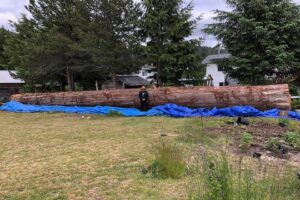
Not long after, Cordeiro began seeking his own log. With help from local contractors, forestry workers and community supporters, a suitable cedar tree was found and delivered to his property. The date it arrived—his late grandfather’s birthday—felt like more than coincidence.
“Your Baba’s watching out for you,” his mother told him.
For Cordeiro, that moment confirmed what he had come to feel: that he was meant to carry the work forward and help revive the nearly lost art of canoe building within the Haisla Nation.
Although he has not yet completed a full-length canoe, Cordeiro has carved two smaller vessels—a 10-foot canoe and a 12-foot hybrid boat—and protected several large logs in anticipation of what comes next. He hopes that once the full-length canoe is completed, it will stand as a physical demonstration of the cultural work he’s been fighting to preserve.
In time, Cordeiro plans to use the space not only to build, but also to protect. His long-term goal is to establish a cultural log reserve on the site—beginning with red cedar—that would remain accessible to Indigenous carvers throughout the North Coast. These logs, sourced with cultural use in mind, would be held in trust and protected from decay or industrial use until ready to be carved.
To support this model, Cordeiro is also advocating for legislative change that would allow Indigenous communities to walk proposed logging areas before harvesting begins. This would enable early identification of trees with cultural importance—such as size, species or historical significance—allowing them to be documented and preserved.
“The idea is to make sure those trees aren’t lost before we even know they’re there,” he said. “It’s about protecting cultural material for the future.”
The canoe shed is the next step. It will provide weatherproof space for carving and storage, safeguard valuable materials, and eventually house equipment and workspaces shared by other carvers. Cordeiro also envisions installing seacans, setting up large log racks, and constructing a covered yard that will become a working hub for culture and craft.
His journey to this point has not been easy. Nearly ten years into sobriety, Cordeiro says his work has become central to his identity and direction.
“This is my purpose now,” he said.

WRITTEN BY:
Brandon Wirsz